Every form and ad lead lands in the CRM within a minute, with its source.
A lead that sits for hours, or waits for someone to copy it into the CRM, is where good marketing work falls apart. I build the piece in between, as one fixed project: the lead arrives in the CRM, the right person gets an alert, and the person who asked gets a first reply.
One installation: one company, one CRM, up to three lead sources.
The leads come in
Website forms (any form that can send a webhook or an email notice), lead forms from Meta Ads and Google Ads, and one inbox for forwarded inquiries.
They land in the CRM
Contact found or created, so no duplicates. A deal or lead record with its source: form, campaign and UTM, where the lead carries them. An owner (fixed, in rotation or by rule) and a callback task with a deadline.
Someone is told
An email or Slack alert to the owner in the same minute, and a reminder if the lead is still untouched after the time you agree on. The person who asked gets a confirmation email in your client's words.
Nothing gets lost
The same lead sent twice is written once. A broken lead goes to an error list with its own alert, so nobody has to notice it by chance.
CRMs: HubSpot, Pipedrive, Airtable, or Google Sheets used as a CRM. Other CRMs with an open API (Zoho, monday.com, Close, Jobber and similar) after a 30-minute check before we start. Built in n8n, or in Zapier or Make if the account already runs on one of them.
For your clients
Built in your client's own accounts and delivered under your agency's name. Your client sees each lead arrive in their CRM with its source, so the leads you generate are visible as yours. Each further client on the same pattern is a fixed $775.
For your own agency
The same build for the inquiries that reach your agency. Every form and ad lead lands in your CRM with its source and an owner, and nobody types it in by hand.
The project is done when these five checks pass.
We run the test together on a video call (or I record it), with the real accounts.
- A test inquiry through every agreed source is in the CRM within 60 seconds, with its source and its owner.
- The owner has the alert in the same minute.
- The person who asked has the first reply.
- The same inquiry sent twice gives one record.
- A broken inquiry (no email, no phone) is on the error list, and the alert for it has arrived.
Passed means all five checks for every source. The 60 seconds count from the moment the form or ad platform receives the lead. If a platform delivers late (Meta sometimes does with lead forms), the test shows that delay separately.
- AccessYou give me admin access to the CRM (or a private app token), the forms or website, and the ad accounts for the lead forms. Plus the list of owners and the rule, the text of the first reply, and one person who answers questions within a business day.
- Build10 business days from complete access.
- TestThe five checks above, with real accounts.
- HandoverA one-page guide and a 5-minute video, so your team can run it without me.
- Fixes14 days after handover, I fix whatever comes up.
$1,275fixed, first installation
- $640At the start.
- $635Once the acceptance test passes.
If the test fails and I can't fix it, the first half goes back to you.
Each further installation
$775 fixed, for another client on the same pattern.
Tools
Paid by the client directly (for example the n8n plan).
- Phone calls, SMS and chatbots.
- Tracking, attribution and client reporting.
- Choosing a CRM or moving to a new one.
Lead claiming
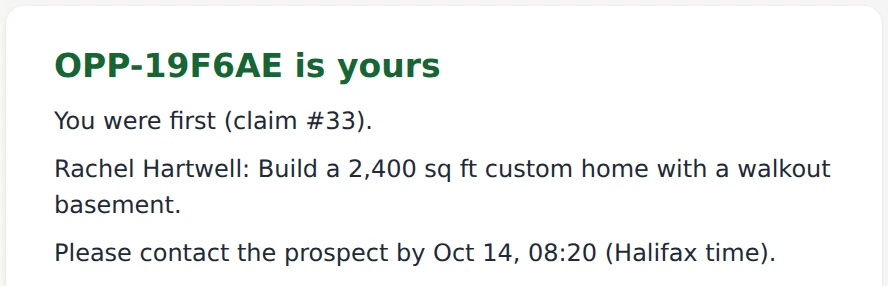
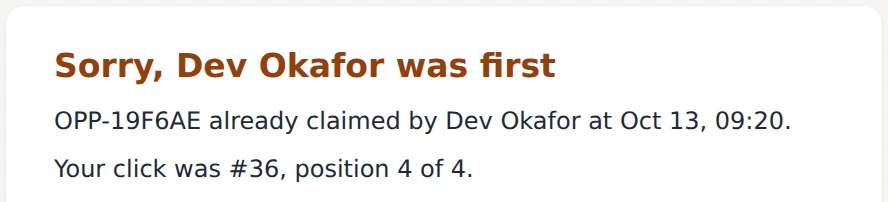
A forwarded inquiry becomes a CRM record. Every account manager gets an alert, and the first one to click owns the lead. A reminder goes out if nobody claims it, and after a deadline the lead moves to the next person in rotation. It runs end to end, with 26 automated tests.

Form to HubSpot
A form submission becomes a contact (found or created), a deal, an owner in rotation and a follow-up task. The same submission sent twice writes nothing the second time.
Shippido LLC
An outbound system inside their Google Workspace, built and handed over.
Walk through it for one client.
30 minutes: which sources, which CRM, and where the leads sit today.